
Enough, Already
Or, How I Realized that Thanksgiving and Passover are the Same Holiday

One year when I was about seven years old, my mother cooked a duck for our Thanksgiving dinner. Both of my parents were refugees, Holocaust survivors, as well as fervent American patriots. I am certain that she wasn’t trying to be clever or ironic; my mother simply didn’t consider any specific cultural expectation regarding what type of roasted bird was to be served. She died more than twenty years ago, and now my father is gone too, so I can’t ask for any additional explanations or clarifications.
But here is what I knew then and still know: evil people had tried to murder them but didn’t succeed; newly married, they had managed to find sanctuary and hope in America; they were now raising a family and grateful for being alive; we were blessed with abundant food for our table. All of that was pretty much the point of this slightly mystifying American holiday, as far as they were concerned. At least no one was trying to convince us to celebrate the birth or resurrection of a Christian savior; all we had to do was heap some extra food on our plates. Chicken was an almost-daily staple, so my mother must have decided that preparing a duck was special. Weren’t we doing it right?
Around this same time I was told, by a friend from the neighborhood, that my parents had “accents.” This news came as a surprise to me, since although I’d been carefully listening to their voices my entire life, I didn’t yet know that there was anything noticeably different about them. Eventually I figured out that my father had renounced speaking his native German after surviving Buchenwald concentration camp and emigrating—first to Sweden, where he met my mother, then to Israel, where they were married, and finally to America, where I and my two siblings were born. My mother—who had survived the Vilna ghetto and a period of hiding in the Polish countryside—still spoke her two mother tongues, Polish and Russian, with her own mother and with her friends, though she shared neither of these languages with my father or with us.
By default, English was our family’s vocabulary. But my parents “talked funny,” according to my friend. After that revelation, I listened for accents in every crowded place, my ears tuned to some exceptional lilt or a word coming from deep in the throat. Signals from worlds I could have known, but didn’t.
We lived in a suburb of Schenectady, New York. This was not only the place my parents chose as being safe enough to raise their three children, it also happened to be the place that chose them. My father, after graduating with a degree in electrical engineering, had been recruited and hired by the chief employer of nearly every adult male in the area, namely: General Electric. As soon as they settled into a small house, my mother quickly curated a group of couples with similar backgrounds, all of them World War Two refugees and Holocaust survivors. This is probably another reason I didn’t at first perceive anything odd about my parents; their closest friends spoke in variations of familiar melodies and imitated each other’s pronunciations. Years later, I would come to understand that what my friend really must have meant was, “your parents come from somewhere else.”
For my father in particular, one of the biggest lessons from the Holocaust was the necessity of dedicating himself to the preservation of Judaism. To that end, he and my mother kept a kosher household, sent us to Hebrew school classes several afternoons a week, and insisted on observing the Sabbath. Every single Friday night we sat in the dining room for our meal; my mother lit candles, my father blessed the challah and the wine, and we ate (you guessed it) chicken. On Saturday mornings, we walked to synagogue—even in winter, even through snow deep as my thighs.
Though there were plenty of children my age who also attended Hebrew School and synagogue, for some reason I tended to gravitate toward friendships with kids who weren’t Jewish. Maybe I was trying to figure out how to fit in to our largely Anglo-Saxon Protestant environment, but I don’t remember making these selections deliberately. My girlfriends and I had much more in common than our backgrounds, or so it felt to me. Every once in a while, I’d invite a non-Jewish friend over for Shabbat dinner, vaguely wondering whether she thought we were “from somewhere else.” Did my friends and I discuss such things back then? I think we may have pretended not to notice, the same way I never asked about the ubiquitous martinis and bridge games and Christmas parties at my friends’ houses.
As I grew older, I fervently resented missing out on basketball games on Friday nights and football games on Saturday mornings. But rules were rules—at least, inside the house. Although my mother kept a kosher kitchen, when we went out to a restaurant for dinner, she would occasionally order a shrimp cocktail as an appetizer. My father would glare and frown, muttering under his breath. My mother insisted she was Jewish “in her own way.” By the time I turned sixteen, I graduated early from high school in a proactive plan of escape from everything and everyone.
Selected as a Rotary International Exchange Student, I was sent to live in the Philippines for a year. This geographic arrangement turned out to be both literally and metaphorically as far from home as I could get without leaving the planet. While I was living with three different Filipino families for four months each, all of whom were practicing Catholics with zero knowledge of Jewish laws, I explained over and over about keeping kosher, politely declining their constant offers of shellfish and pork. Delicacies! They insisted my priest would absolve me, but I surprised myself by adhering to my upbringing and to my father’s emphatic religious preferences. It was the first time I discovered that what I ate was an opportunity to decide who I was on the inside, a way to stay true to myself. I became my own country.
I can say now that it took me quite a few more years to notice that Passover was the holiday most relevant to the backstory of slavery, liberation, exile, and adopted homeland that shaped my parents. Long before I deeply understood these striking resemblances, though, I was well aware of the focus on an elaborate meal with symbolic foods. There were forbidden ingredients and just as many obligatory ones; there were tastes of tears and also several glasses of wine. By the end of the seemingly endless meal, the song “Dayenu,” with its repetitive chanting of dayy, dayy-enu, oh dayy, dayy-enu, dayy dayenu, dayenu dayenu, effectively turns the concept of “enoughness” into both a dirge and a celebration. If only this had happened, but not this, it would have been enough for us…. Praise for being saved from destruction, praise for abundance and full bellies, praise for being able to lift voices in prayer. Already enough. Enough already.
My mother died of breast cancer at the age of 70, when I was 40. Less than a decade later, I was diagnosed with breast cancer too, though I’m incredibly lucky the disease didn’t take my life. I don’t call myself a survivor, though. I say, I went through treatment for breast cancer. (I have, in essence, written an entire book about this subject.) This past April, my father died at the age of 93. A few days before he passed away, on April 11th, we commemorated the 77th anniversary of his liberation from Buchenwald. This anniversary often coincides with the start of Passover, and this year was no exception. The night of April 15th was the night of the first seder. All of my father’s children and grandchildren gathered at his home for the holiday, and we stood in the living room in a circle around his hospital bed. We sang “Dayenu,” and he joined us in singing a few words too. The next morning, he stopped breathing.
I’m about to turn 66 years old. I’ve come to believe that there is really only one story and that we are all either telling it or listening to it, the story that has loss or near-disaster somewhere in the beginning or middle. Maybe it brings us to tears or to our knees; maybe we are overcome by a deluge of water or sorrow; maybe we are swarmed by locusts or cells gone wild. Maybe fear of the dark threatens to ravage every chance of happiness, or maybe there is a fire burning out of control in the secret chambers of our hearts. Maybe we can’t quite remember why we have been trying so hard to be good, or why we are pushing these boulders up the steepest hill again and again. Maybe we just can’t remember who we are. Forgetting is so easy.
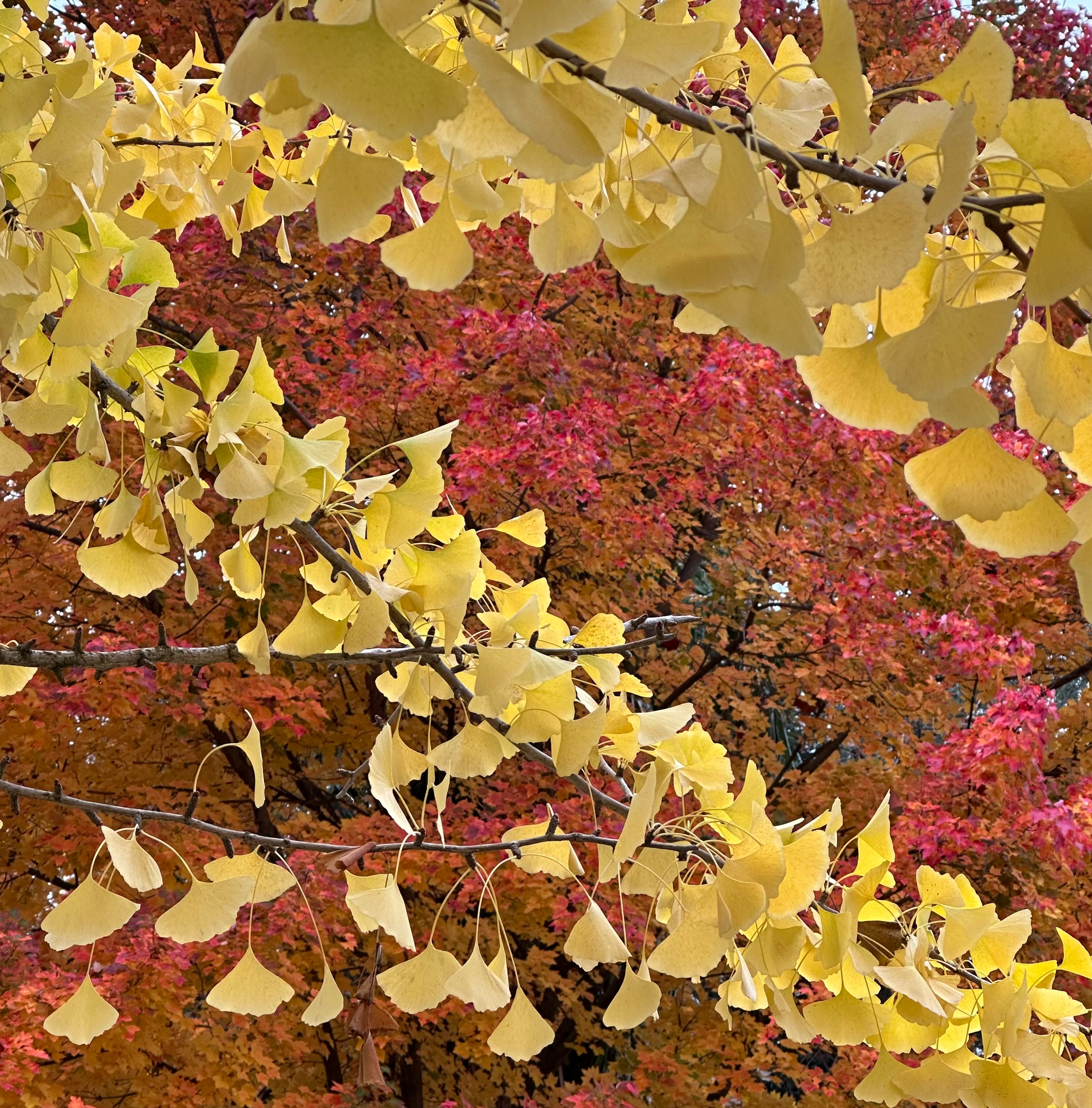
And yet. If we are what we eat then whether the meal is served with a roasted bird or greens dipped in salt water, this sharing of hearts and minds and bodies and breath has the power to bring us back to ourselves. We can look into each other’s eyes and know that even in the coldest part of winter or in the whispered promise of spring, under layers of dead leaves and scarred soil, a new return to life is beginning. What seems lost is merely dormant before the next awakening. What we can learn and re-learn together is that we are enough, we are exactly enough and more. We are already full of everything we need, and there is so much more to go around. There is more and more and more.
(Note: Twenty years ago, in November 2005, I wrote a much shorter version of this, as a prose poem. You can find that here: https://elizabethrosner.com/enough-already-or-how-i-realized-that-thanksgiving-and-passover-are-the-same-holiday/ )
There really is only one story and I enjoyed learning the details of yours. Loved you got to sing with your father as he exited his body.
"What seems lost is merely dormant before the next awakening." -- beautiful