
Another Trip

A friend sent me an invitation to join a “once-in-a-lifetime” trip to Egypt next summer to witness the solar eclipse in the middle of the White Desert. The invitation was filled with exclamation marks and a few photographs and some links to the website for the tour guide, an American ex-pat married to an Egyptian. The descriptions were so enticing and her enthusiasm so infectious, I wrote back to my friend saying I was interested. Her next messages explained that parts of the trip might be physically challenging, but our Bedouin guides would be taking very good care of us. We’d be a small group getting to witness something extraordinary and stunning and private, while all the fancy trips and travelers spending many more thousands of dollars would not be getting access the way we would. Etcetera.
It was when she mentioned armed guards that I realized I needed to ask about my particular safety as a Jewish woman traveling in the Middle East. “I’ll ask D. what she thinks,” my friend said. The next thing she sent was cut and pasted from D.: “As for the Jewish woman and her ability to travel around Egypt, it depends a lot whether she’s a combative Zionist or just a normal Jewish person. I know a Russian Jew from Miami who’s married to an Egyptian and lives in Cairo, and she has no problem among the educated middle class. But I don’t know if she’d be comfortable being openly Jewish in other contexts like strangers or just uneducated people who might have prejudices. As long as she doesn’t have Israel on her passport, it shouldn’t be a problem. If she does - then you’re looking at increased security for her.”
I wrote back. “‘Combative Zionist or just a normal Jewish person.’ Quite a statement. I’m going to pass. Thank you for sharing the note.”
My friend wrote: “I don’t think she means to be offensive… she just means someone who’s pro-Netanyahu and loud about it... pro-war. ‘Just a normal Jewish person’ is someone who cherishes their heritage but not as outspokenly political. …She says that Egypt is striving very hard to not to be drawn into the larger war because Egypt depends enormously on tourism. I think that alone causes some anti-Israel sentiment, which would then be extrapolated, albeit not accurately, onto any person of Jewish heritage.”
Belatedly, I clicked on the link for D.’s website. She was “born in a small town in Poland and grew up in Arizona.” She explains that her “family crossed the Iron Curtain for a new life in the American Southwest. And my experiences as an immigrant taught me to look beyond my own culture and see life through a broader lens.”
My mother was born in Poland too. She and her parents survived the war after managing to escape from the Vilna Ghetto just before it was liquidated. They were hidden in the Polish countryside by a farmer whom they paid with jewelry and gold coins. Even after the Russians pushed the Nazis out and liberated Poland, it still wasn’t “safe” for Jews to remain in Poland, my mother said. It took me a long time to understand that most Poles hated the Jews almost as much as the Nazis did. They even murdered Jews after the end of the war, just the way they had murdered Jews for centuries.
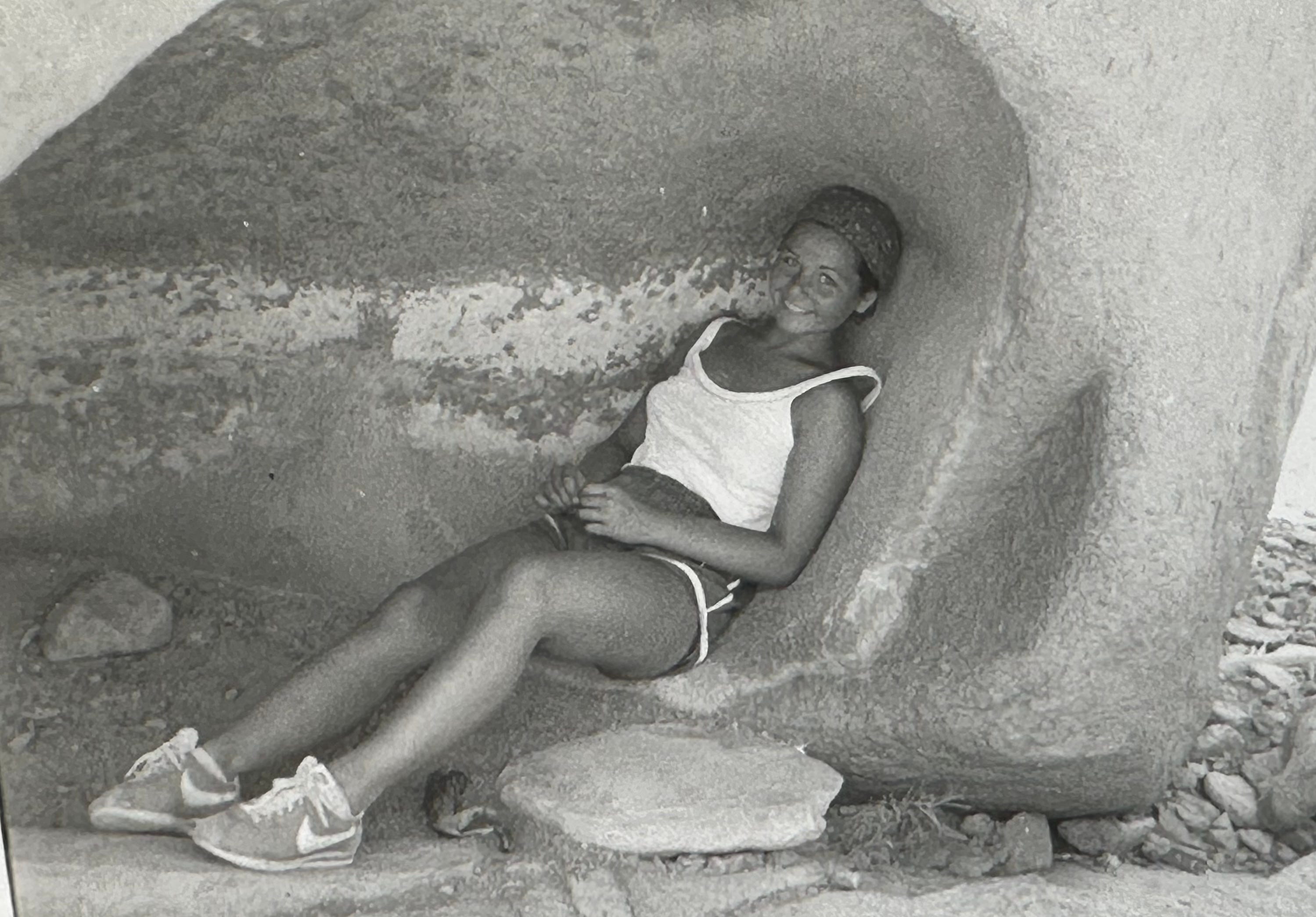
More than 46 years ago, I spent a few days hiking in the Sinai Desert with my Israeli boyfriend. That was the summer following the signing of the Egypt-Israel peace treaty, in which Egypt—under the leadership of Anwar Sadat—became the first Arab country to officially recognize Israel. We were with another Israeli couple too; all three of them were finishing up their mandatory military service, and they all spoke fluent Arabic. My boyfriend arranged with a Bedouin man to carry our backpacks on his camel; they would meet up with us at night, at an agreed-upon location. I’ll never forget the tea cooked on an open fire, the camel nearby in the darkness, our sleeping bags under the sky, the profusion of stars that took my breath away. During the days, we climbed Mount Sinai, and we swam in the stunning water of an oasis. My Adidas sneakers didn’t always quite match the endurance of my friends’ army boots, but I managed.
Amazingly, I haven’t ever returned to Israel since then, although my extended family living there numbers into the hundreds, especially on my father’s side. His mother’s parents and aunts and uncles all left Germany in 1933, when Hitler came to power. They were Zionists. My own grandmother and grandfather stayed in Germany, however. They thought it was safe, the “most civilized country in the world,” according to my father, who was quoting his mother. My father’s youngest brother survived by being sent on a kindertransport to Sweden. My father and the middle brother both survived Buchenwald concentration camp. That brother went to live in the newly established state of Israel, joining many of his relatives who had already been living there for more than 15 years.
Two of my six books have been translated into Hebrew. For decades I have hoped to be invited to Israel for a book festival or to give a lecture of one sort or another. I know that the country I visited 46 years ago is not the same country that I would find today. I have forgotten most of the Hebrew I once knew, and I don’t imagine visiting my cousins in Bnei Brak, where they are observant Ultra-Orthodox Jews who arrange marriages for their children and study in Yeshiva all day. And I will not be joining the solar-eclipse once-in-a-lifetime trip to Egypt with my friend. I will hold onto my memories of that other desert, the one in which I wandered as a fearless 20-year-old wearing a tank top and shorts and a bandana holding back my long hair. I only wish I could see those astonishing stars again.
I see a ⭐️
Wonderful. And that photo is so you !!! A book festival in Israel would be amazing.