Against forgetting:
a few words on the 80th anniversary of the liberation of Auschwitz

“We have failed to understand that a world with an Auschwitz cannot be mended. The ambition of trying to make it good again is wrong. It detracts from the serious job of understanding. It happens each time. The wars over memory, the distortions—simply because a genocide leaves a hole in the heart of the world that cannot be filled.”
This statement comes from journalist Konstanty Gebert, an expert in comparative genocide, who is quoted by Tanya Gold, in her brilliant piece in Harpers Magazine (https://harpers.org/archive/2024/09/my-auschwitz-vacation-tanya-gold-tourism/).
As some of you know, as a daughter and granddaughter of Holocaust survivors, I spent years (most of my life, really) working on what he calls “the serious job of understanding.” I also acknowledge that “a world with an Auschwitz” ultimately defies understanding. Because no matter how many times I immerse myself in the study of explanations and theories and photos and testimonies, no matter how many times I have sat with first-hand witnesses and listened to their detailed memories, no matter how many times I have attempted to memorize the experiences of my parents in order to keep them alive and to share them with others —- these efforts always fail to bring me to a place of what I consider to be true “understanding.”
I keep trying. I’ve written books about this seemingly endless trying. I’ve given lectures and led writing workshops and responded to interviewers and to questions and confrontations from perfect strangers. I’ve drawn connective lines between the Holocaust and other genocides; I’ve named the hole in my own heart and the holes I recognize in the hearts of others; I’ve struggled to imagine us learning how not to fear and hate and kill each other.
Today, on the 80th anniversary of the liberation of history’s most notorious killing machine, I feel compelled to say something, even though my voice is small and choked with sorrow. We are already forgetting. The evidence is everywhere. Is it too late to try harder to understand the impossible, because it is the truth?
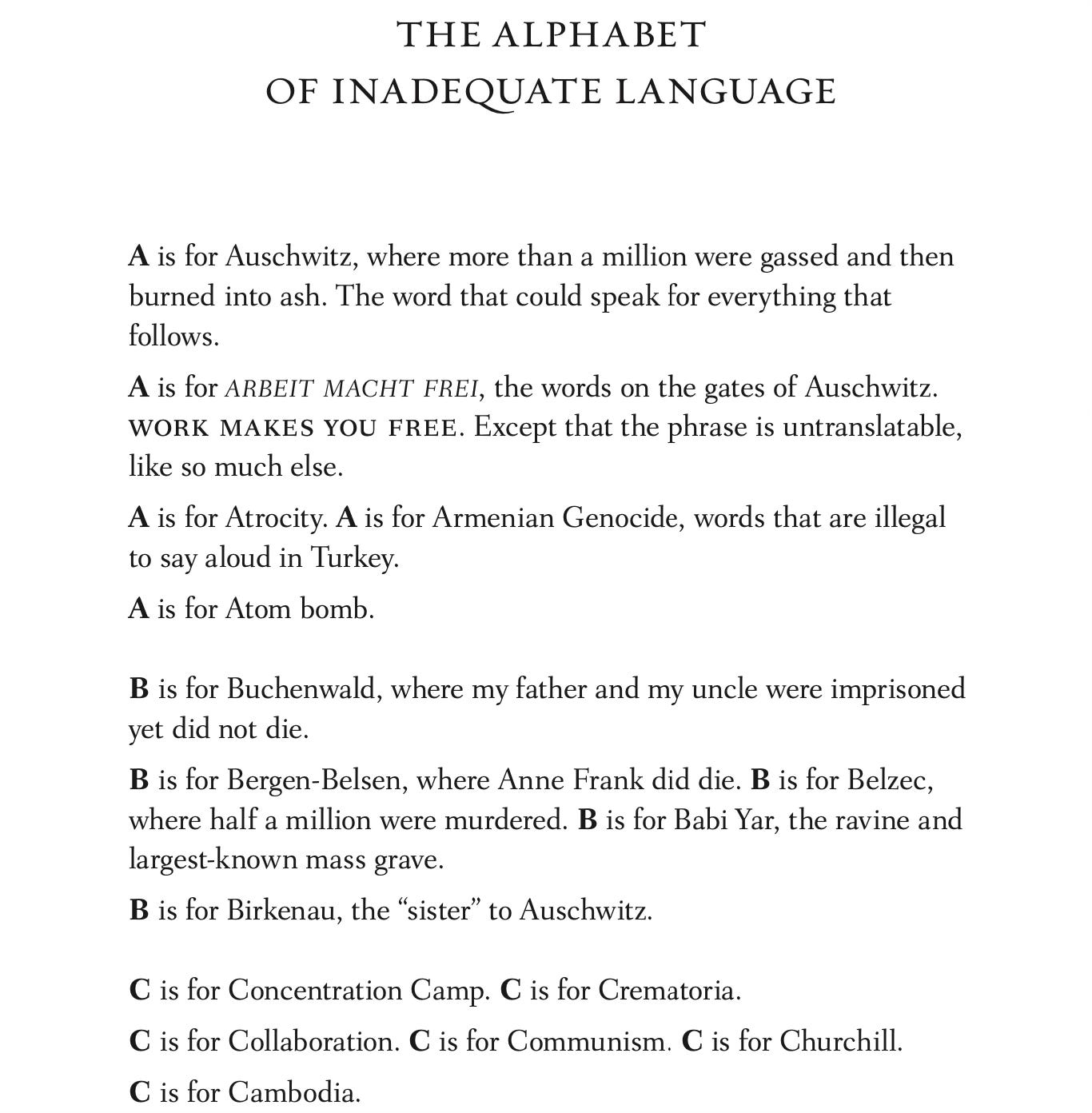
(below are the opening pages from SURVIVOR CAFE: The Legacy of Trauma and the Labyrinth of Memory)
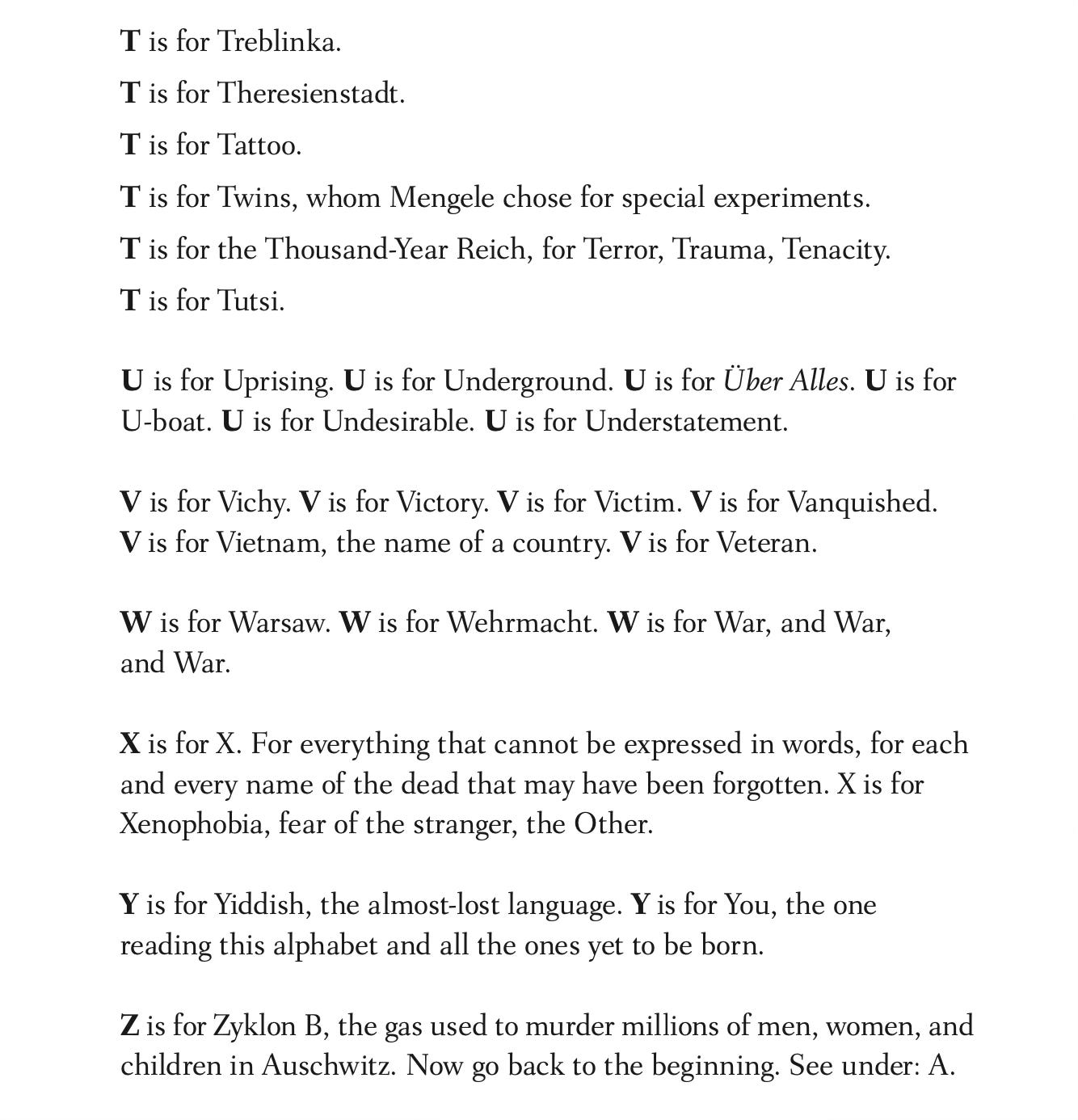
(last page of the alphabet follows)